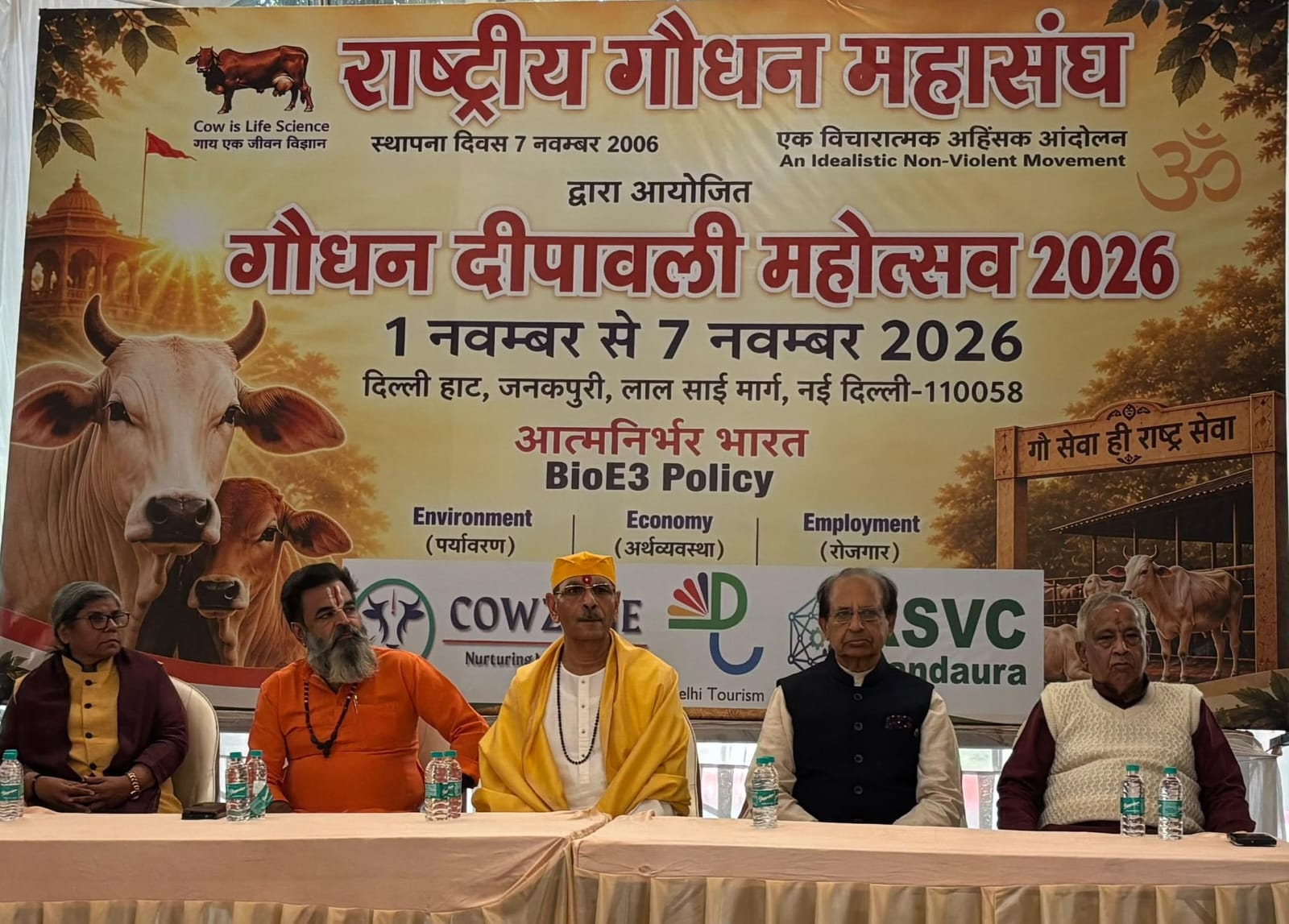
NEW DELHI: Aiming to move beyond viewing cow conservation solely through a religious and cultural lens and integrate it into self-reliance, rural economy, and employment generation, the seven-day 'Rashtriya Godhan Deepawali Mahotsav 2026' commenced with great fervor at Dilli Haat, Janakpuri. Organized by the Rashtriya Godhan Mahasangh, the festival runs from November 1 to 7, 2026, placing a sharp focus on strengthening the vital links between cow protection, environmental sustainability, indigenous production, and economic self-sufficiency.
The event was formally inaugurated with traditional Vedic rituals, havan, and Gau Puja. The opening ceremony was presided over by Prof. Jagdish Mukhi, former Governor of Assam and President of the Godhan Deepawali Mahotsav. The inauguration was graced by notable dignitaries, including spiritual guru and founder of Vishwa Jagriti Mission Sudhanshu Ji Maharaj; Ms. Vijaya Sharma, North Zone Pracharika and All-India Taruni Pramukh of Rashtra Sevika Samiti, renowned preacher Sant Vikasanand Ji, Satish Chhikara, State President of Bharatiya Kisan Sangh (Haryana), Former MLA Madan Lal, Rajesh Rishi, former MLA from Janakpuri, Vijay Khurana, Convener of the Rashtriya Godhan Mahasangh, and festival in-charge Monika Arora. Following the Vedic ceremony and cow-related activities, Mahaprasad was distributed to devotees and visitors.
The festival is being held in active collaboration with the Delhi Tourism and Transportation Development Corporation (DTTDC), Cowzone, Sanatan Dharam Pratinidhi Sabha (Delhi), Vishva Hindu Parishad (VHP), Bharatiya Kisan Sangh, and the Confederation of NGOs of India. DTTDC is serving as the official venue partner, hosting the festival at Dilli Haat, Janakpuri. The expo remains open to the public daily from 9:00 AM to 9:00 PM throughout its run.
More than 400 stalls featuring gaushalas, cow-care advocates, and social organizations from across the country have been set up. These stalls display a wide array of cow dung and cow urine-derived products, Panchagavya formulations, organic fertilizers, incense sticks, eco-friendly lamps, and natural personal care goods. The expo demonstrates modern, practical models to help gaushalas leverage available resources and achieve economic viability.
Addressing the gathering, spiritual guru Sudhanshu Ji Maharaj emphasized that alongside domestic cattle rearing, sheltering stray and abandoned cattle is a paramount duty. He highlighted the urgent need to restore soil fertility depleted by chemical fertilizers, urging the establishment of village-level bio-compost and biogas plants to enhance farmers' incomes.
Ms. Vijaya Sharma noted that cow conservation forms the backbone of sustainable organic farming and protects cultivable land from degradation. She called upon women and youth to lead this transition, noting that cow dung and cow urine are not agricultural wastes, but natural elixirs that restore mother earth’s vitality while fostering widespread environmental awareness.
In his presidential address, Prof. Jagdish Mukhi stressed the commercial dissemination and market reach of cow-based products. He remarked that as demand and market value for dung and urine increase, the economic viability of cattle will naturally safeguard them from neglect and harm. He also announced plans for a dedicated initiative to shelter abandoned, non-lactating cattle and urged the government to allocate land to make city roads free of stray animals.
Vijay Khurana, National Convener of the Rashtriya Godhan Mahasangh, underscored that the core mission is to transition gaushalas from mere welfare shelters into active hubs of rural enterprise and job creation. By establishing sustainable processing and marketing networks for cow-based goods, local livelihoods can be nurtured while preserving indigenous traditions.
On the concluding day, November 7, a solemn tribute will be paid to the ascetics and activists who made the supreme sacrifice during the historic 1966 Cow Protection Movement on Parliament Street. The organizers have invited farmers, entrepreneurs, researchers, and citizens to visit the festival and actively participate in this movement toward sustainable, cow-centric economic self-reliance.